A World-Class Deposit Hidden Beneath Tennessee Farmland
Elmwood Mine sits beneath rolling farmland near Carthage in Smith County, Tennessee, roughly 50 miles east of Nashville. From the surface, there was nothing to suggest that the ground below contained one of the most spectacular fluorite deposits ever discovered. The mine's economic reason for existence was zinc — specifically the zinc sulfide mineral sphalerite, which was extracted industrially for decades. But it was the gangue minerals — the crystalline byproducts of the ore formation process — that made Elmwood famous among mineral collectors worldwide.
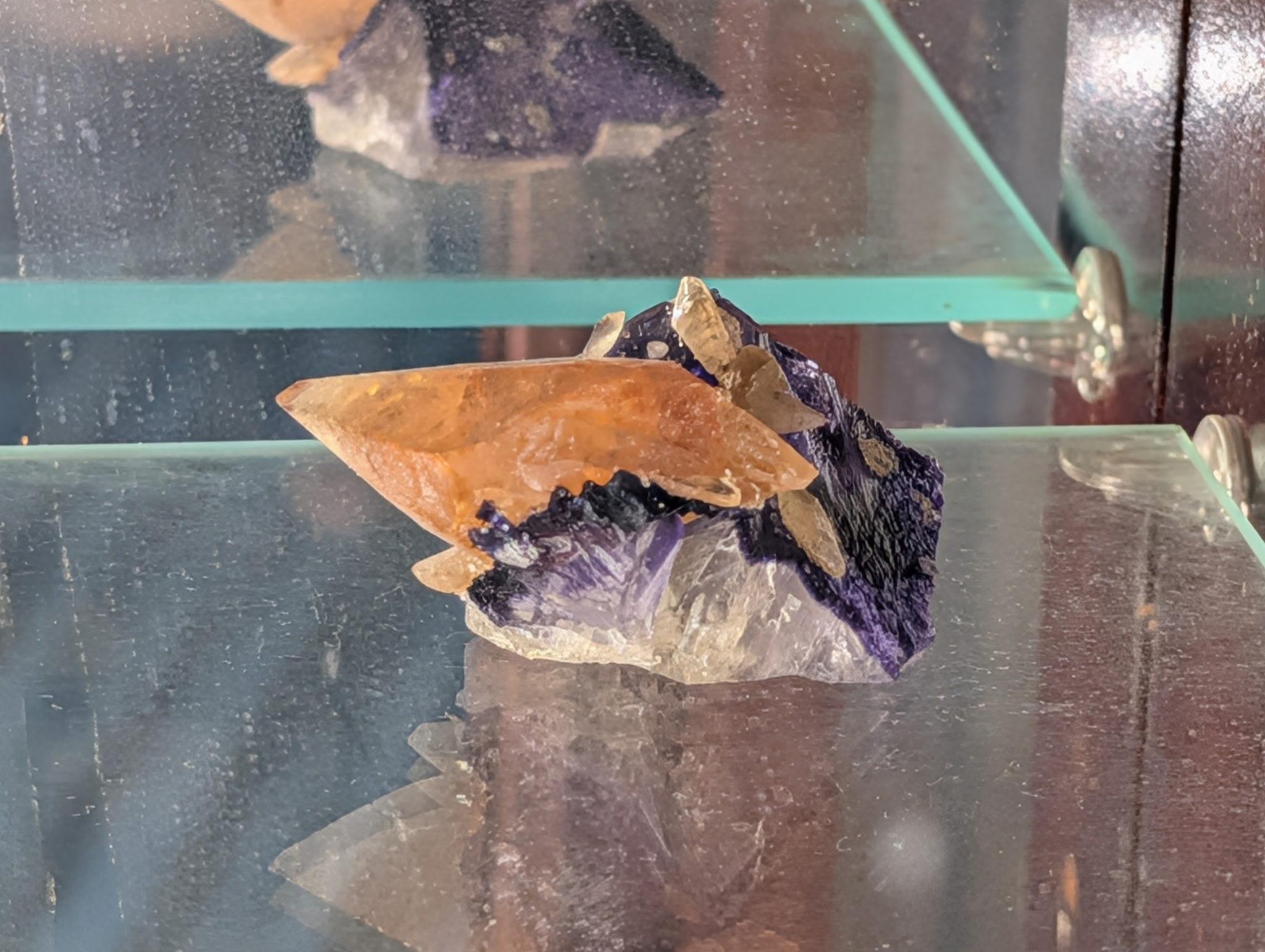
The deposit belongs to a class of ore systems called Mississippi Valley-Type (MVT) deposits, named for their prevalence across the central United States. Elmwood sits within the Central Tennessee Zinc District, a cluster of MVT deposits hosted in ancient Ordovician carbonate rocks. What separated Elmwood from its neighbors was the extraordinary size, color, and crystal perfection of its fluorite specimens — deep purple to violet cubic crystals, often sitting on beds of honey-gold scalenohedral calcite, with occasional sphalerite and barite adding complexity to the assemblage.
Why Elmwood Fluorite Is Recognized Globally
The Smithsonian Institution holds 27 documented Elmwood specimens, among the most of any single American fluorite locality. Major natural history museums including the American Museum of Natural History and the Rice Northwest Museum of Rocks and Minerals have acquired top-tier Elmwood pieces. The mine appears in at least 7 peer-reviewed mineralogical publications and in the Smithsonian's formal provenance documentation — recognition reserved for deposits of genuine scientific and aesthetic significance.
Geological Setting: The MVT Formation Process
Mississippi Valley-Type deposits form through a process fundamentally different from the volcanic and hydrothermal systems that produce most ore deposits. There is no magma, no igneous intrusion, no volcanic activity. Instead, hot saline brines — ancient basin fluids heated by deep burial — migrate upward and laterally through porous carbonate rocks, carrying dissolved metals like zinc and lead. When these metal-rich fluids encounter sulfur-bearing waters already present in the host rock, the sulfides precipitate: sphalerite for zinc, galena for lead.
Elmwood's host rock is the Mascot-Jefferson City Dolomite, an Ordovician-age carbonate approximately 450 million years old. The dolomite had been fractured and dissolved into open cavities (vugs) by groundwater over millions of years. When the mineralizing brines arrived, these open spaces became the crystallization chambers where exceptional specimens formed. Fluorite, calcite, and barite — the gangue minerals — filled the remaining void space in spectacular crystal form.
Why the Crystals Were So Exceptional
Two factors converged to make Elmwood specimens extraordinary. First, the cavity size: Elmwood's vugs were unusually large, giving fluorite crystals room to grow without crowding or contact damage. Individual cubic fluorite crystals exceeding 5 centimeters on a face were documented — remarkable for any fluorite deposit. Second, the chemistry: the specific composition of the mineralizing fluids at Elmwood produced fluorite with an intense, saturated purple-to-violet coloration caused by trace amounts of rare-earth elements and natural radiation damage to the crystal lattice.
Mineralogical Profile
| Mineral | Formula | Crystal System | Hardness | Significance at Elmwood |
|---|---|---|---|---|
| Fluorite | CaF₂ | Isometric (cubic) | 4 Mohs | Primary collector mineral; deep purple to violet cubes; world-class crystal size and color saturation |
| Calcite | CaCO₃ | Trigonal/rhombohedral | 3 Mohs | Honey-gold to amber scalenohedral crystals forming matrix beneath fluorite; essential component of best specimens |
| Sphalerite | ZnS | Isometric | 3.5–4 Mohs | Primary ore mineral (economic zinc); dark resinous crystals; prized by collectors for complex habit |
| Barite | BaSO₄ | Orthorhombic | 3–3.5 Mohs | Tabular white-to-colorless crystals; occurs with fluorite in multi-mineral specimens |
| Galena | PbS | Isometric | 2.5 Mohs | Minor lead sulfide; silvery metallic cubes and octahedra on select specimens |
Mine History
Mining operations begin at Elmwood under the New Jersey Zinc Company, which controls much of the Central Tennessee Zinc District. The economic target is sphalerite; fluorite and calcite are initially regarded as gangue waste.
Miners begin encountering spectacular fluorite and calcite vugs during zinc extraction. Awareness spreads among the mineral collecting community that Elmwood is producing specimens unlike anything previously seen from the Tennessee district. Early collectors acquire pieces directly from miners.
Peak collecting period. The Elmwood Mine becomes recognized internationally as one of the finest American mineral localities. Major museum acquisitions occur during this period — the Smithsonian, American Museum of Natural History, and other institutions acquire landmark specimens. Asarco assumes operational control from New Jersey Zinc. Collectors and dealers negotiate systematic access to vug material during blasting operations.
Continuing operations yield additional extraordinary specimens, though access to the best collecting areas becomes more restricted. Academic publications begin formally documenting the deposit's mineralogy, establishing Elmwood's place in the scientific literature. Prices for top specimens rise substantially as the finite nature of the supply becomes understood.
Mine closes permanently. Asarco ceases operations at Elmwood. The orebody is largely depleted, and no economically viable zinc ore remains. With the mine closed, no new specimens will ever be extracted. Every Elmwood specimen in existence was collected during the mine's operating life — the supply is genuinely and permanently finite.
Why Elmwood Specimens Command Premium Prices
Three intersecting factors explain why Elmwood fluorite sits at the top of the American specimen market:
1. The Mine Is Closed — Permanently
Elmwood closed in 2003 and will not reopen. The zinc orebody that justified its operation is depleted, and no economic case exists to reopen the mine for its fluorite alone. Unlike operating quarries where a collector can theoretically obtain new material, Elmwood is done. Every specimen in existence today was extracted before 2003. The supply can only shrink as specimens leave the market, are placed in institutional collections, or are damaged. There is no restocking mechanism.
2. Museum-Grade Quality That Has Never Been Matched
The combination of large cubic crystals, deep saturated purple coloration, and the aesthetic contrast with honey-gold calcite matrix has not been replicated at any other fluorite locality worldwide. Exceptional Chinese fluorite, English Blue John fluorite, and Mexican specimens each have their merits — but none produce the specific Elmwood aesthetic: massive, perfectly formed purple cubes on sparkling amber calcite. The 27 Smithsonian specimens and holdings at AMNH are not diplomatic acquisitions — they are there because no other American fluorite competes on those terms.
3. Documented Institutional Provenance
Elmwood is one of a small number of American mineral localities with formal Smithsonian provenance documentation and at least 7 peer-reviewed academic citations. This institutional record creates an authentication baseline that supports serious collector and museum-level transactions. Buyers at the top of the market require documented provenance, and Elmwood's record is among the strongest of any American locality.
Academic Record and Museum Holdings
Elmwood's scientific documentation is unusually thorough for an industrial mine, reflecting the exceptional quality of its specimens and the attention they attracted from mineralogists over several decades:
- Smithsonian Institution — Formal provenance documentation; 27 cataloged specimens in the national collection, making Elmwood one of the most represented American fluorite localities in the national museum.
- American Museum of Natural History (AMNH) — Holdings include display-quality fluorite and calcite specimens from the peak collecting period.
- Rice Northwest Museum of Rocks and Minerals — Elmwood specimens in the permanent collection, including documented large-cabinet and museum-grade pieces.
- James Madison University (JMU) Collection — Academic collection with Elmwood specimens used for mineralogical study and provenance reference.
- Peer-Reviewed Publications (7+) — Academic literature includes mineralogical characterization of the deposit, crystal morphology studies, and geochemical analysis of the MVT formation process. Publications establish the scientific record that underpins provenance claims.
Collector Market and Valuation
Elmwood fluorite occupies the premium tier of the American specimen market. Prices are driven by crystal size, color saturation, matrix quality, and the presence of associated species (calcite, sphalerite, barite). Post-2003, all price trends have been upward as supply contracts and awareness grows.
| Specimen Tier | Size | Price Range | Market Notes |
|---|---|---|---|
| Thumbnail | Under 1″ | $200–$500 | Entry collector pieces. Genuine Elmwood locality, visible crystal structure and color. Good introduction to the deposit. |
| Cabinet | 1–3″ | $800–$2,500 | Prime collector grade. Multiple cubic crystals with calcite matrix. Comparable to dealer retail at major mineral shows. |
| Large Cabinet | 3–5″ | $2,500–$5,000 | Institutional-grade display quality. Deep color saturation, well-formed crystals, exceptional matrix. Museum acquisition tier. |
| Museum / Investment | 5″+ | $5,000–$7,500+ | Exceptional specimens. Documented Smithsonian-comparable quality. Investment-grade with strong long-term appreciation trajectory. |
Where Elmwood Specimens Trade
Top-tier Elmwood material moves through specialist auction houses including Heritage Auctions and Bonhams, which have established benchmark prices for museum-quality pieces. Established mineral dealers — The Arkenstone (iRocks.com), Pala International, and Fine Mineral International — carry documented Elmwood inventory and provide provenance certification. Mineral shows including Tucson and Denver offer broader selection, though the best pieces rarely reach the show floor. Privately negotiated transactions between known collectors account for a significant share of premium specimen movement.
The critical pricing variable is color depth and crystal perfection. Elmwood fluorite ranges from pale lavender to nearly opaque indigo-purple — the deepest, most saturated specimens command multiples of the entry price. Secondary factors: undamaged crystal faces, matrix quality (honey calcite is preferred over white or brown), specimen completeness, and any documentation of collection history or previous ownership by recognized collectors or institutions.
Our Collection
EcoFabLab by L3 LLC holds authenticated Elmwood Mine fluorite specimens from the mine's operating period. Each piece is cataloged with full mineralogical data, locality provenance, and specimen documentation. Browse individual specimens below, or request a private showing to examine pieces in person.