A Locality Known by Many Names
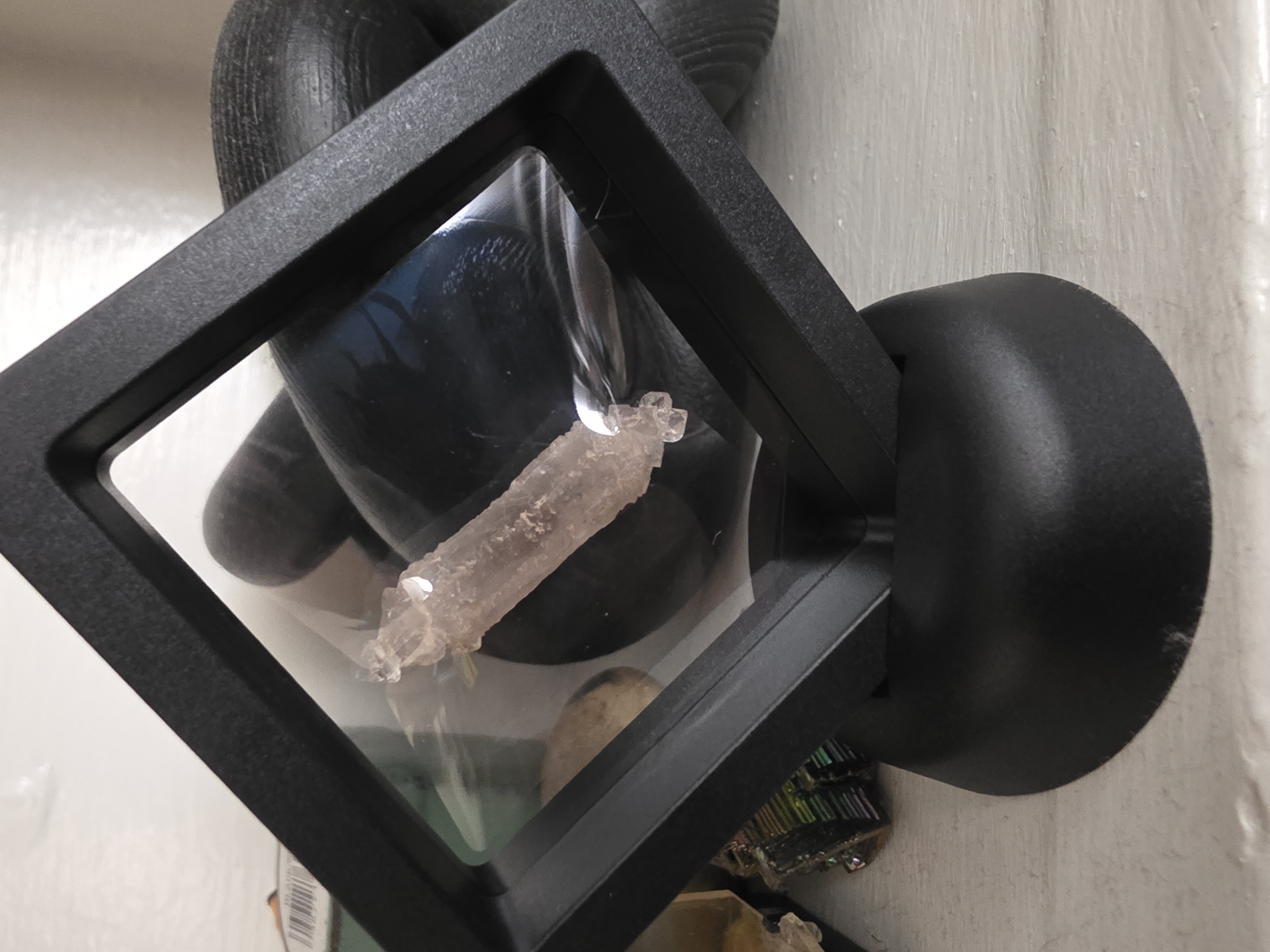
The quartz crystals from Smyth County, Virginia carry more colloquial names than almost any other American locality. Collectors who encounter these crystals for the first time often reach for the same word: diamond. When freshly collected from a field vug in clay-rich Virginia soil, a well-formed Saltville quartz crystal has a glassy brilliance and geometric perfection that genuinely evokes a diamond under hand-lens magnification.
Each name captures a different facet of the same material: the locality (Saltville), the geography (Blue Ridge, Appalachian), and the visual quality that earns them their nickname. These are not marketing terms — they are documented collector names that have circulated in the American mineral hobby for decades.
Geological Setting: Saltville Thrust, Smyth County
The crystals form within the Saltville Thrust sheet — a major structural feature in the Valley and Ridge province of southwestern Virginia. The Saltville Fault surfaces over two miles northwest of the town of Saltville, a community historically known for its salt seeps, brine wells, and gypsum deposits. At depth below the fault, halite (rock salt) and gypsum occur within intensely deformed Cambrian and Ordovician strata. That deformation history is directly encoded in the quartz crystals growing above it.
The Saltville area experienced repeated episodes of shearing, compression, and hydrothermal fluid movement. Tension gash fractures — extensional cracks that open perpendicular to maximum compression — provided the voids where quartz precipitated. These fractures are narrow in unweathered bedrock, but as limestone weathers to residual clay soils over millions of years, the fractures open further and crystals are released as free-floating specimens in pale, light-colored soil matrix.
The Moccasin Formation: Ordovician Deep Time
The host rocks belong to the Moccasin Formation, a Middle Ordovician carbonate sequence deposited approximately 450–480 million years ago. During this period, Virginia lay submerged beneath a shallow tropical sea. Limestones and limy shales accumulated on the seafloor, incorporating organic-rich sediments and marine carbonate minerals.
The Knox Unconformity marks the moment when sea levels fell dramatically, exposing the underlying carbonates to erosion and weathering. The Saltville area straddles this boundary, producing the characteristic dark limy shales and shaly limestone above the post-Knox unconformity that host the quartz crystals. Silica-rich hydrothermal fluids mobilized by Saltville Thrust tectonics infiltrated this zone and precipitated quartz in the resulting vugs and fractures.
Why the Unconformity Matters
The post-Knox weathering horizon created increasingly porous limestone. Hydrothermal fluids infiltrated this zone and precipitated quartz in the resulting vugs. The organic material trapped in the Ordovician sediments was incorporated into the growing crystals. Four hundred and fifty million years later, it remains visible as black phantoms and amber halos inside perfectly clear quartz.
Mineralogical Profile
| Property | Details |
|---|---|
| Mineral | Quartz |
| Chemical Formula | SiO₂ |
| Crystal System | Hexagonal (trigonal subdivision) |
| Hardness | 7 on the Mohs scale |
| Specific Gravity | 2.65 |
| Luster | Vitreous; mirror-like on best crystal faces |
| Color / Transparency | Colorless to pale smoky; dark anthraxolite phantoms; amber halo zones from organic impurities |
| Crystal Habit | Prismatic and bi-pyramidal doubly-terminated; scepter forms; knobby capping crystals at both terminations; prismatic and bi-pyramidal occur side by side in same field |
| Locality | Saltville area, Smyth County, Virginia, USA (also Broadford area) |
| Host Formation | Moccasin Formation, Middle Ordovician (~450–480 Ma) |
| Structural Setting | Saltville Thrust sheet, Valley and Ridge province |
Morphological Diversity: What Separates Saltville from Every Other Quartz Locality
Most quartz localities produce one dominant crystal habit. Arkansas produces long prismatic points. Tennessee produces bi-pyramidal doubly-terminated crystals. Herkimer County produces short blocky doubly-terminated crystals. Saltville produces all of these forms simultaneously — prismatic and bi-pyramidal side by side in the same soil layer.
The reason is the squeezed, deforming growth environment. Crystals grew inside tension gash fractures while the surrounding rock continued to deform under tectonic stress. Re-healing of broken crystal surfaces is observable in many specimens — direct evidence that growth was interrupted by deformation events and then resumed, adding new crystal material over fractured faces. This stop-start growth record is encoded in the internal structure of every Saltville crystal.
The result is a locality where no two crystals are identical. A single field collection might include short fat bi-pyramidal doubly-terminated crystals, long slender prismatic points, blocky equant forms, and knobby multi-generation specimens. This variety is unique in the eastern United States and is the primary reason serious collectors maintain dedicated Saltville specimen drawers.
Scepter Crystals: Why Virginia's Ratios Are Remarkable
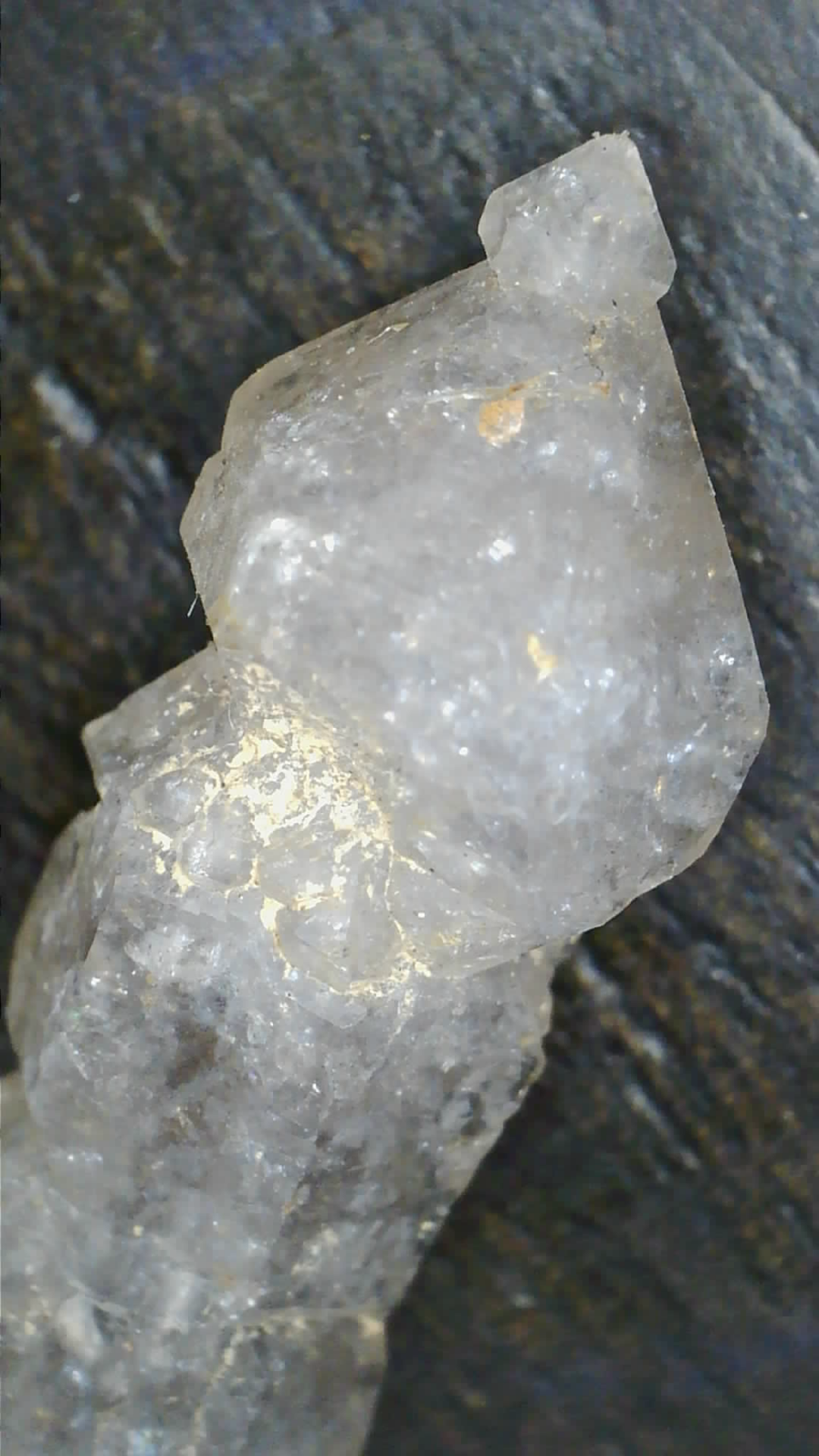
A scepter crystal forms when a quartz crystal's growth pauses, silica-rich fluid chemistry shifts, and growth resumes on a different crystal face — producing a secondary "head" that overhangs the original "stem" like the head of a scepter.
The 1-in-1,000 Threshold
At most quartz localities worldwide, sceptered crystals represent approximately 1 in every 1,000 crystals collected. Virginia's Saltville area localities are specifically noted among mineralogists for scepter ratios that significantly exceed this baseline. The Porterfield Quarry in nearby Rich Valley (Smyth County) is documented as producing scepter-type crystals at rates that surprise even experienced collectors. This elevated ratio indicates that fluid chemistry shifts triggering scepter formation occurred repeatedly and extensively across the Saltville Thrust zone.
Double-terminated scepters — specimens where both terminations are preserved AND a scepter head is present — are exceptionally rare. They result from a specific "pocket run": a localized episode within a single vug where silica-rich fluids changed chemistry mid-growth, creating a run of scepter-form crystals before conditions returned to normal.
Dark Inclusions: Anthraxolite and Ordovician Organics
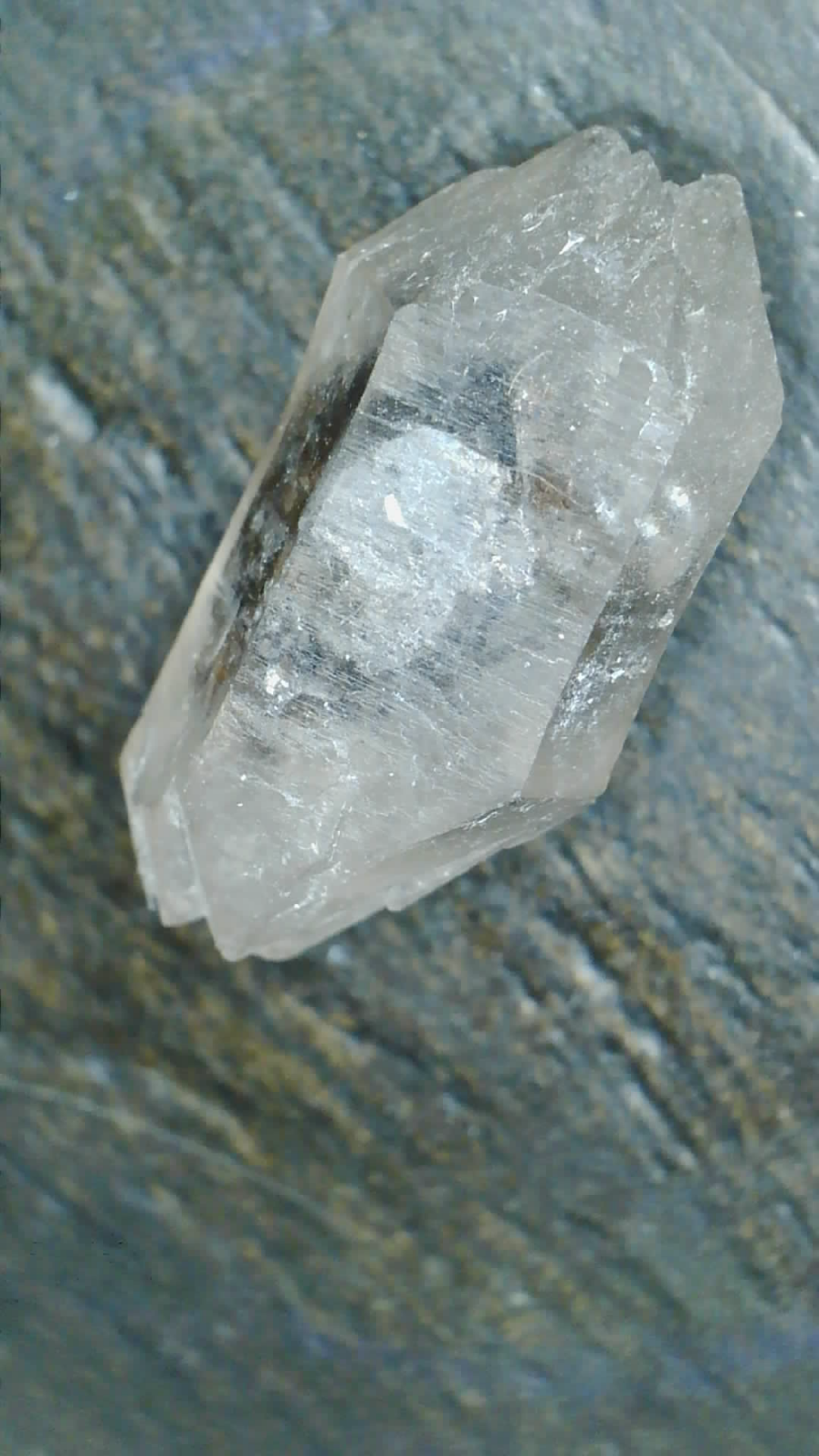
The most distinctive feature of premium Saltville quartz is the presence of black internal phantoms. These inclusions are composed of anthraxolite or related carbonaceous hydrocarbon material — ancient organic matter trapped during the Ordovician period when the Moccasin Formation sediments were accumulating on the seafloor.
As silica-rich fluids grew the quartz crystals, they incorporated fine particles of this organic carbon into the early growth zones. The result is a characteristic internal phantom — a black ghost of an early crystal stage visible inside the later, larger overgrowth. In many specimens, the boundary between the dark phantom and the clear outer quartz produces an amber-colored "halo" effect — organic impurities bleeding into the surrounding silica matrix.
Why This Matters to Collectors
The anthraxolite inclusions and amber halos are geological documentation. A crystal with a well-defined black phantom and amber halo is demonstrating its complete growth history: early equant crystal stage (dark), chemistry change (amber transition), and final clear overgrowth. Collectors who understand Virginia mineralogy specifically seek these specimens as the authentic Saltville type. The inclusions confirm genuine Ordovician-age material — they cannot be faked or induced post-collection.
Collector Market and Significance
The supply situation parallels every other Old Stock American mineral locality. Active collection from private land near Saltville has become increasingly restricted. The most significant collections were assembled by dedicated Virginia collectors over decades — Allen Penick of Lexington, Virginia is frequently cited as a key early collector whose estate material formed the basis of many notable dealer lots. When those estate collections are sold, they are not replenished.
| Specimen Type | Size | Market Context | Notes |
|---|---|---|---|
| Common crystals (lots) | ½–1″ | $8–25 per lot | Entry-level. Typical bi-pyramidal and prismatic forms, minimal inclusions. |
| Individual display specimens | 1–2″ | $20–60 per piece | Good clarity, well-formed faces. Suitable for labeled specimen trays. |
| Old Stock with anthraxolite | ½–1.5″ | $40–120 per piece | Black phantom inclusions + amber halo. Premium for confirmed Virginia provenance. |
| Scepter specimens | 1–3″ | $75–250 per piece | Clean scepter form, good head definition. |
| Double-terminated scepters | 1–3″ | $150–400+ | Both terminations intact. Rare. Premium scales sharply with condition and documentation. |
Our Collection
EcoFabLab by L3 LLC holds Smyth County scepter quartz specimens from the Saltville area, including double-terminated scepter examples with anthraxolite phantom inclusions and characteristic amber halos. Browse our collection, or request a private showing to examine pieces in person.